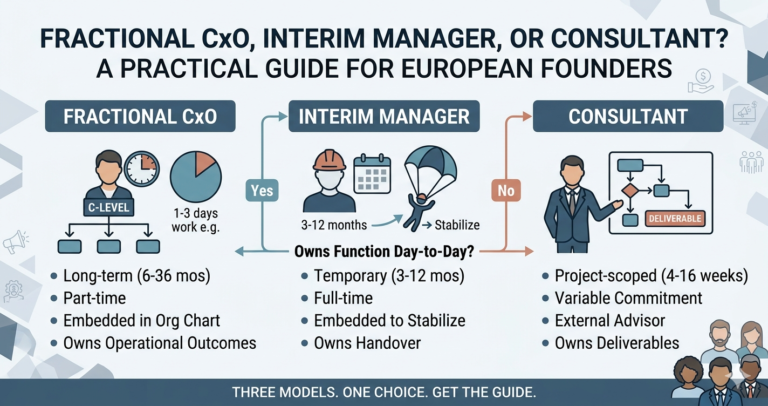
Fractional CxO, Interim Manager, or Consultant? A Playbook for European Companies

Three models. Overlapping vocabulary. Very different outcomes. Here’s how to pick the right one.
Every European founder eventually hits the same decision. A function — Finance, Marketing, Technology, People — has outgrown what the team can handle, but hiring a full-time executive feels premature, expensive, or both. The choice usually comes down to three models: fractional vs interim manager vs consultant. The vocabulary overlaps so much that founders use the terms interchangeably, then wonder why the engagement they chose didn’t deliver what they expected.
These three models solve different problems. Choosing the wrong one wastes runway, frustrates the team, and delays the real solution. This guide walks through how each actually works in practice, where they overlap, and which is right for your situation.
Fractional vs interim manager vs consultant: the three models
Fractional CxO. A senior executive who takes on a C-level role part-time — typically one to three days per week — for an ongoing engagement measured in months or years. They sit in the org chart, own outcomes, manage a team, and often split their week across two or three companies. Fractional is the model of choice when you need real executive leadership but the role doesn’t yet justify a full-time hire.
Interim Manager. A senior executive who takes on a C-level role full-time, but temporarily — usually three to twelve months — to stabilize a function during a crisis or transition. Common triggers: a sudden CxO departure, a restructuring, a carve-out, a turnaround. Interim managers parachute in, stabilize the function, and hand over to a permanent successor.
Management Consultant. An external advisor or firm engaged to deliver a specific project: a strategy, an assessment, a transformation roadmap, a market entry plan. They work alongside the leadership team but do not sit in the org chart, do not manage permanent staff, and are accountable for deliverables rather than ongoing operational outcomes.
Side by side: seven dimensions that matter
| Dimension | Fractional CxO | Interim Manager | Management Consultant |
|---|---|---|---|
| Engagement duration | 6–36 months, often longer | 3–12 months | 4–16 weeks, project-scoped |
| Commitment pattern | Ongoing part-time (1–3 days/week) | Full-time, temporary | Project-based, variable intensity |
| Scope of authority | Sits in the org chart, owns a function | Shadow leader with full authority during tenure | External advisor, no formal authority |
| Pricing model | Monthly retainer | Day rate, full-time equivalent | Project fee or day rate |
| Team integration | Embedded — manages people, sets direction | Embedded temporarily — stabilizes team | External — works with the team, not in it |
| Accountability | Owns ongoing operational KPIs | Owns stabilization and handover | Owns defined deliverables |
| Exit dynamics | Gradual wind-down or conversion to full-time | Hard handover to permanent successor | Project ends, report delivered |
The seven dimensions cluster into one underlying question: Does this person own the function day to day, or do they help the people who own it? Fractional and interim both say yes. Consultants say no.
Three realistic scenarios
Scenario 1 — Series A scaleup needs a CFO
A Berlin SaaS company, 40 employees, €4M ARR, preparing for Series A in nine months. The founder has been running finance with a bookkeeper and a part-time controller. The round will require proper FP&A, board reporting, and investor-grade metrics — but a full-time CFO at €180K+ makes no sense until after the round closes.
Right answer: Fractional CFO. Two days a week, 12-month engagement. Builds the financial model, runs the data room, coaches the founder through board updates, and either converts to full-time post-round or hands over to a permanent hire.
Scenario 2 — Manufacturing SME loses its COO
A family-owned manufacturer in Austria, 180 employees, €40M revenue. The long-serving COO resigns with three months’ notice. The search for a permanent successor will take six to nine months. The operation cannot be leaderless for that long.
Right answer: Interim COO. Full-time, six to nine months, day rate. Keeps the plant running, manages the direct reports, and works closely with the CEO to define the profile for the permanent successor and onboard them on arrival.
Scenario 3 — Scaleup enters a new market
A Dutch fintech, 90 employees, considering expansion into France. The founders need a go-to-market strategy, regulatory assessment, competitive landscape, and a phased entry plan. They have strong internal leaders but no European expansion experience.
Right answer: Management Consultant. Eight-week project, fixed fee, clearly defined deliverables. Produces the strategy and roadmap. Execution stays with the internal team.
When fractional vs interim manager roles blur
In practice, engagements often evolve between models. A fractional CMO covering a maternity leave can become an interim arrangement if the permanent hire falls through. A consulting engagement that identifies a deep operational problem can turn into an interim mandate to fix it. A fractional CTO embedded for 18 months may gradually scale down as the team matures into a pure advisory role.
This fluidity is a feature, not a problem — but only if the contract anticipates it. Build review points into any engagement over three months. Decide together whether to extend, convert, or wind down. The worst outcomes come from fractional engagements that drift into consulting (senior person, no authority, no outcomes) or interim roles that never end (full-time cost, no succession plan).
European realities that change the math
The three models look the same on paper across geographies. In practice, European operating conditions shape which one is feasible.
False self-employment risk. Germany (Scheinselbständigkeit), Austria, and the Netherlands all have regulations that reclassify contractors as employees when the engagement looks too much like a permanent job. A fractional CxO working four days a week, exclusively for one client, over many months will trigger scrutiny. Two-to-three-day-per-week engagements across multiple clients are structurally safer. Full-time interim arrangements usually go through interim management providers with proper employment contracts precisely to avoid this risk.
Contractor classification in France. French labor law is particularly strict about the boundary between prestation de services and salariat déguisé (disguised employment). Fractional engagements need clear written scope, independent decision-making, and genuine multi-client activity.
VAT and cross-border invoicing. A fractional CFO based in Vienna serving a client in Munich invoices across EU borders with reverse-charge VAT. Practical, but requires proper VAT IDs on both sides. Consulting firms handle this routinely; individual fractionals need to set it up deliberately.
GDPR and data access. Any external leader — fractional, interim, or consultant — who touches HR data, customer data, or financial records needs a Data Processing Agreement and appropriate system permissions. Interim managers typically get full access; fractionals get scoped access; consultants often work with anonymized extracts. Get this right before day one, not after.
A four-question decision framework
When you’re not sure which model fits, run through these in order:
- Is the need ongoing or temporary? Ongoing → fractional or full-time hire. Temporary → interim or consultant.
- Does the role own operational outcomes, or deliver a project? Operational outcomes → fractional or interim. Project deliverables → consultant.
- Is this part-time or full-time? Part-time → fractional. Full-time (temporarily) → interim.
- Does the organization need someone in the chain of command? Yes → fractional or interim. No → consultant.
Most real-world mismatches happen at question two. Founders hire consultants when they actually need someone to run the function, or hire fractionals when they actually need a bounded project. Getting question two right prevents most disappointment.
The short version
A fractional CxO fits when you need ongoing executive leadership but can’t justify full-time cost. An interim manager fits when a function needs immediate full-time stabilization. A consultant fits when you need analysis, strategy, or a roadmap — not a leader.
The models are complementary, not competitive. Many successful companies use all three at different stages. The skill is matching the model to the problem, not picking a favorite. The fractional vs interim manager vs consultant decision isn’t about picking a favorite — it’s about matching the model to the problem.
Fractionista is Europe’s marketplace for fractional C-level executives. If the fractional model fits your situation, browse candidates on Fractionista to find the right fit for your company.