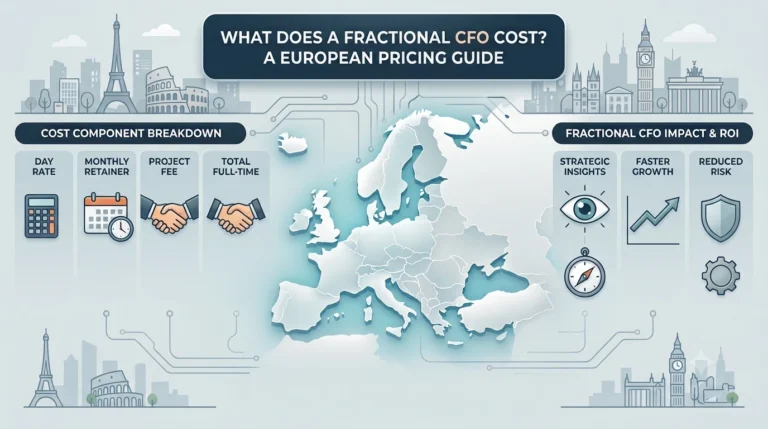
What Does a Fractional CFO Cost? A European Pricing Guide

The fractional CFO cost question is usually the first one managers and company owners ask, and it deserves a straight answer. In Europe, most fractional CFO engagements land between 800 and 1,500 euros per day, or between 3,000 and 8,000 euros per month on a retainer basis. The honest answer behind those numbers is more nuanced, because what you pay depends on scope, seniority, and how the engagement is structured. This guide breaks down the real cost drivers so you can budget with confidence.
The short answer: typical fractional CFO rates in Europe
Because every engagement is negotiated directly between the company and the executive, there is no fixed price list. There are, however, clear market patterns. Based on what we see across the European and especially the DACH market, three pricing models dominate.
Day rates
Most fractional CFOs quote a day rate. In the DACH region, experienced fractional CFOs typically charge between 1,000 and 1,500 euros per day. Executives with a narrower specialization, for example Series B fundraising or carve-outs, can command more. In markets with lower cost levels, or for CFOs earlier in their fractional career, rates of 800 to 1,000 euros per day are common.
Monthly retainers
For ongoing engagements, which is the core of the fractional model, a monthly retainer is the most practical structure. A typical setup of one to two days per week translates into 3,000 to 8,000 euros per month, depending on the day rate and the agreed scope. Retainers give both sides predictability: the company can budget, and the CFO can commit the capacity.
Project-based fees
Some situations are better priced as a package: preparing a financing round, building an investor-ready financial model, or setting up controlling from scratch. Project fees vary widely, but a useful mental model is the day rate multiplied by a realistic effort estimate, plus a margin for the outcome responsibility the CFO takes on.
What drives the price up or down
Two CFOs with the same title can be priced very differently, and for good reason. These are the factors that move the needle most.
Seniority and track record. A CFO who has closed institutional funding rounds, led an exit, or built finance functions in several scaleups brings pattern recognition that a controller stepping up simply does not have. That experience is exactly what you are paying for, and it is reflected in the rate.
Scope of the role. Strategic finance leadership, fundraising support, and board reporting sit at the top of the value chain. If the engagement also includes hands-on work such as cleaning up accounting processes or implementing tooling, the total time commitment grows, even if the day rate stays the same.
Industry fit. A CFO who knows your business model, for example SaaS metrics, manufacturing cost accounting, or marketplace unit economics, is productive from week one. That shortens the ramp-up and often justifies a premium.
Commitment level and duration. Longer commitments at higher weekly volume usually come with a better effective rate. A CFO committing two days per week for twelve months will typically price more favorably per day than one booked for a two-week sprint.
Fractional CFO vs. full-time CFO: the real comparison
The day rate of a fractional CFO looks high until you compare it with the full cost of a permanent hire. In the DACH region, a full-time CFO at a funded startup or mid-sized company typically earns a base salary between 150,000 and 250,000 euros. On top of that come employer social contributions, which in Austria and Germany add roughly 30 percent, plus bonus, equity, recruiting fees, and the three to six months it takes to fill the role.
Put together, a full-time CFO realistically costs 200,000 to 350,000 euros per year before equity. A fractional CFO at two days per week costs roughly 60,000 to 100,000 euros per year, with no recruiting fee, no severance exposure, and a start date measured in days rather than months.
The comparison only makes sense, however, if the role genuinely does not require full-time attention. For most companies between seed and Series B, it does not. The finance function needs senior judgment a few days per week and solid execution underneath, not an executive at full capacity. If your company has outgrown that stage, a full-time hire is the right call, and a fractional CFO can bridge the search and onboard the successor.
The contract side: what European companies need to get right
In Europe, and particularly in Germany and Austria, pricing and contract structure are connected. Fractional CFOs work as independent contractors, and the engagement must be set up so that it actually is one. The keyword in the DACH region is Scheinselbständigkeit, or false self-employment.
In practice, this means the fractional CFO works with their own equipment, controls how and when the work gets done within the agreed scope, carries entrepreneurial risk, and typically serves multiple clients. A well-structured fractional engagement meets these criteria naturally, because working across several mandates is the essence of the model. What you should avoid is a contract that reads like a part-time employment agreement: fixed daily working hours, full integration into the org chart with disciplinary authority over the CFO, or exclusivity clauses.
For the budget, this also means there are no employer social contributions on top of the invoice. The CFO invoices as a business, usually with VAT, which is a pass-through item for most companies. What you see on the invoice is what the engagement costs.
How to budget for a fractional CFO: a practical framework
A simple way to arrive at a realistic budget in four steps:
1. Define the outcomes, not the hours. Write down the three to five results you need in the next six to twelve months, for example an investor-ready financial model, monthly reporting the board trusts, or a financing round closed.
2. Estimate the weekly rhythm. Most companies at seed to Series B stage need one to two days per week. More than three days per week is a signal that you may need a full-time hire or additional operational support below the CFO level.
3. Apply the market rate. Multiply the weekly days by a realistic day rate for your market and requirements. For a first budget, 1,200 euros per day is a sensible midpoint for the DACH region.
4. Plan for a defined period, then review. Set the engagement up for three to six months with a clear scope, then review outcomes and adjust. Good fractional CFOs welcome this, because it keeps the relationship anchored in results.
Frequently asked questions
Is a fractional CFO cheaper than a consultant?
The day rates can look similar, but the models differ. A management consultant delivers analysis and recommendations, then leaves. A fractional CFO sits in your organization, owns the finance function, and is accountable for outcomes over months or years. For ongoing financial leadership, the fractional model delivers substantially more value per euro. We compare the models in detail in our guide on fractional CxOs vs. interim managers vs. consultants.
Do fractional CFOs charge for onboarding?
Yes, the ramp-up phase is paid working time. A seasoned fractional CFO keeps it short, typically one to two weeks of higher intensity to understand the business, the numbers, and the team. Be skeptical of anyone who promises value without investing time to understand your company first.
What does a fractional CFO cost for a very early-stage startup?
Pre-seed and seed companies often need less than a day per week. Some CFOs offer advisory-style engagements of two to four days per month, which lands in the range of 2,500 to 5,000 euros per month. An advisory board role can be an even lighter alternative at that stage.
Are there placement fees or commissions?
That depends on how you find your CFO. Traditional interim agencies charge margins on every invoiced day or a placement fee. On Fractionista, companies and executives connect directly and negotiate terms between themselves, with no commission on the engagement. The platform operates on a subscription model for companies, which keeps the cost structure transparent.
The bottom line
A fractional CFO in Europe costs between 3,000 and 8,000 euros per month for a typical one to two day per week engagement, driven by seniority, scope, and market. Compared with the 200,000 euros or more that a full-time CFO costs annually, the fractional model gives companies between seed and Series B access to senior financial leadership at a fraction of the cost, with the flexibility to scale the engagement as the company grows.
If you are weighing the decision, start with the outcomes you need and the weekly rhythm they require. The rest is a negotiation between you and the right executive.
Ready to talk to experienced fractional CFOs directly? Learn how to hire a fractional CFO through Fractionista, or read our complete guide to working with a fractional CFO.