What Is a Fractional Role? A Complete Guide to Fractional Executives in 2026

A fractional role is a part-time senior executive engagement where a single professional takes on a defined leadership mandate — typically one to three days per week — for one or more companies in parallel. It’s the answer to a question more founders and CEOs are asking: “We don’t need a full-time CFO. We need a great one, for two days a week, for the next nine months.”
The model isn’t new, but its scale is. The global fractional executive market was worth $9.4 billion in 2025 and is projected to reach $24.7 billion by 2034, growing at a compound annual rate of 11.3% (Dataintelo, 2026). Gartner forecasts that more than 30% of midsize enterprises will have at least one fractional executive on retainer by 2027 (Gartner, cited in Fractionus industry research).
This guide explains what fractional roles actually are, how they differ from interim, consulting, and advisory work, and when they’re the right choice for a company — or for an executive considering the switch.
What Is a Fractional Role? (The Short Definition)
A fractional role is an ongoing part-time executive engagement in which a senior operator holds a named leadership seat (for example, Fractional CFO or Fractional CTO) inside a company for a committed fraction of their working time.
Three characteristics define it:
- Seat, not project. The fractional executive holds a functional role — they are the CFO, CMO, or Head of Product for that time. They don’t advise from outside.
- Part-time and parallel. The engagement is typically one to three days per week, and the executive usually serves two to four companies at once.
- Ongoing, not one-off. Engagements run three to eighteen months on average, often longer. This is not a single workshop or a fixed-scope project.
The simplest way to picture it: one experienced operator, sliced across multiple companies that each need senior leadership but not five days of it.
How Does a Fractional Role Work?
Fractional engagements are structured around four variables:
| Variable | Typical range |
|---|---|
| Time commitment | 1–3 days per week (8–25 hours) |
| Engagement length | 3–18 months, often extended |
| Pricing model | Monthly retainer, day rate, or equity + cash mix |
Most fractional executives work on a monthly retainer rather than hourly billing. The retainer buys a fixed allocation of time, attendance at leadership meetings, and a named seat — which means the executive shows up on the org chart, not just in consulting reports.
Unlike consultants, fractional executives operate inside the company: they use the company email, attend the executive team meeting, present at board meetings, and own decisions. Unlike full-time hires, they don’t take equity packages, annual bonuses, or long notice periods. The relationship is designed to scale up, scale down, or end cleanly as the company’s needs change.
According to recent industry data, companies onboarding a fractional executive through a structured platform reach measurable impact in 30–45 days, versus six to nine months for a typical full-time C-suite hire (Fractional C-Suite research, 2026).
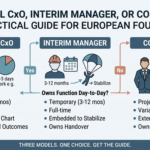
Fractional vs. Interim vs. Consultant vs. Advisor
The four terms get used interchangeably, and they shouldn’t be. Here’s the distinction:
| Model | Role | Time | Typical duration | Primary purpose |
|---|---|---|---|---|
| Fractional | Holds the seat part-time | 1–3 days/week | 3–18 months (ongoing) | Sustained leadership without full-time cost |
| Interim | Holds the seat full-time | 5 days/week | 3–12 months | Bridge during a gap (exit, maternity, restructure) |
| Consultant | Outside expert | Project-based | Weeks to months | Specific deliverable or recommendation |
| Advisor | Informal sparring partner | 1–4 hours/month | 1–3 years | Strategic input, network, credibility |
The fractional-interim distinction is the one most people get wrong. Interim is full-time and temporary — a parachute for a vacant seat. Fractional is part-time and embedded — a permanent operating model where the company deliberately chooses not to have a full-time executive in that function right now.
A consultant writes the strategy; a fractional executive runs it. An advisor meets you for coffee once a month; a fractional executive is in your leadership meetings every week.
Common Fractional Roles
Fractional roles exist across the full C-suite and increasingly in Head-of-Function positions below it. The most established are:
- Fractional CFO — financial planning, investor reporting, fundraising prep, M&A readiness. The most mature fractional function globally.
- Fractional CMO — brand positioning, demand generation, category strategy, agency management. Particularly common in B2B SaaS and scaling startups.
- Fractional CTO — technical strategy, architecture, team building, vendor selection. Especially useful for non-technical founders.
- Fractional COO — operations, process design, scaling infrastructure, cross-functional alignment.
- Fractional CRO / Head of Sales — sales motion design, pipeline discipline, hiring the first full-time sales leaders.
- Fractional CPO (Product) — product strategy, roadmap governance, product-market fit diagnosis.
- Fractional Chief of Staff — founder leverage, operating cadence, executive team orchestration.
Newer variants are emerging faster than most job titles can keep up with — fractional AI officers, fractional sustainability leads, and fractional M&A integration heads, among others. The functional breadth is expanding because the underlying logic (buy senior expertise in the exact dose you need) applies to almost any leadership role.
Why Companies Hire Fractional Executives
Companies choose fractional over full-time for four reasons, in rough order of how often they come up:
1. Cost. A great full-time CFO in Europe costs €180,000–€300,000 per year in total package. A fractional CFO covering the same scope at one to two days per week costs €60,000–€150,000 — with no severance risk, notice period, or equity dilution. Industry data puts the total saving at 40–60% versus full-time (Ignite Bright industry research, 2025). The European average day rate for interim and fractional senior executives sits at €994, according to the INIMA 2024 survey of 850 practitioners across eleven countries (INIMA Report 2024, via DDIM).
2. Seniority the company couldn’t otherwise afford. A seed-stage startup cannot hire an ex-Series-C CFO full-time. It can hire that same person fractionally. Fractional is the only mechanism that gives early-stage companies access to late-stage experience.
3. Speed to impact. Full-time executive search takes three to six months and has a meaningful failure rate. Fractional engagements typically start within two to four weeks and are designed to deliver measurable outcomes in the first 45–60 days.
4. Optionality. Fractional engagements can be ended, paused, or converted to full-time with weeks of notice. For companies navigating uncertainty — fundraising cycles, market pivots, M&A — this flexibility is strategically valuable in ways that full-time contracts cannot replicate.
There’s a fifth reason that’s rarely stated but often the real driver: founders don’t always know what they need. Hiring full-time for a role you don’t fully understand is expensive tuition. Hiring fractional is a lower-stakes way to figure out what the role actually requires before committing.
Why Executives Choose Fractional Work
The growth of the supply side is just as dramatic as the demand side. The number of fractional executives globally doubled from roughly 60,000 in 2022 to 120,000 in 2024 (Frak Conference State of Fractional Industry Report, cited via Fractionus), and LinkedIn profiles containing the word “fractional” have grown by orders of magnitude in the same period.
Executives move into fractional work for three typical reasons:
- Portfolio career. Three engagements at €8,000/month each generates €24,000 monthly, often exceeding a full-time salary in the same role — with more variety, less politics, and significantly more control over the calendar.
- Life stage. Post-exit founders, executives returning from sabbatical, and senior leaders in the second half of their careers often don’t want another five-day-a-week role. Fractional lets them stay operational without the grind.
- Impact per hour. Many senior operators find that 80% of their contribution in a full-time role happened in 20% of their hours. Fractional formalizes the math.
The model requires different skills than employment: the ability to diagnose quickly, to prioritize ruthlessly, to build trust across multiple leadership teams, and to run a business of one. Not everyone who tries it succeeds at it.
When Does a Fractional Role Make Sense?
Fractional is the right choice when at least two of the following are true:
- The company needs senior expertise it can’t afford full-time, or can’t justify full-time yet.
- The role’s scope is clearly defined for the next 6–12 months.
- The company’s trajectory is uncertain enough that flexibility matters.
- There is no internal candidate ready to be promoted, but a full search would take too long.
- The function is important but not the CEO’s primary focus (e.g., finance for a product-led founder).
Fractional is usually not the right choice when:
- The role requires full-time presence with the team (e.g., a hands-on VP Engineering in a 50-person tech org).
- The work is fundamentally cultural and identity-shaping over multiple years.
- The company needs someone to embody the function externally (customer-facing CEO roles, for example).
- The scope is so ambiguous that no one knows what the first 90 days should deliver.
A useful filter: if you can write a one-page mandate describing what the fractional executive should own and what success looks like in 90 days, a fractional role probably fits. If you can’t, hire a consultant to help define the mandate first — then decide.
The European Fractional Market in 2026
Europe lags the US in fractional adoption but is closing the gap quickly. Roughly 20% of European businesses have implemented some form of fractional hiring, projected to reach 30% by 2026 (Vendux LLC, 2024). Western Europe — particularly the UK, the Netherlands, Germany, and the DACH region — leads adoption, with Southern and Eastern Europe following.
Several structural factors are accelerating adoption specifically in Europe:
- Regulatory clarity. Contractor classification frameworks have stabilized in most EU jurisdictions, reducing the legal uncertainty that slowed the model in the early 2020s.
- Remote work normalization. A fractional CFO in Vienna can serve companies in Munich, Zurich, and Amsterdam without relocating anyone.
- Cross-border expansion. European companies entering new EU markets increasingly use fractional executives who already know the regulatory and operational landscape, reducing market-entry risk.
- The exit generation. A wave of European founders who exited between 2018 and 2024 is now entering the fractional market, bringing operator credibility that was scarce a decade ago.
The DACH region in particular has seen the rise of structured fractional marketplaces and platforms that make the model easier to access for mid-market and scaleup companies that would previously have defaulted to full-time hires or traditional consulting engagements.
How to Find the Right Fractional Executive
Three paths, in order of speed:
- Warm network. Still the dominant channel — 47% of senior interim and fractional mandates in Europe are placed through personal networks, with a further 32% going through specialist providers, according to the INIMA European survey of 850 practitioners (INIMA Report 2024). Fast, high-trust, but limited to who you already know.
- Specialized platforms. Fractional marketplaces curate and vet senior operators, reducing search time from months to weeks. Quality varies widely — the best platforms have single-digit acceptance rates and structured matching processes.
- Executive search firms. Traditional option, higher cost, slower, but thorough for senior and sensitive mandates.
Whichever path you choose, the work that matters most happens before the search: writing the mandate. A clear 90-day outcome brief is worth more than ten candidate conversations without one.
Frequently Asked Questions
How many hours per week does a fractional executive work? Typically 8–25 hours per week, structured as one to three fixed days. The time is usually concentrated rather than spread thin — most fractional executives block full days rather than an hour here and there.
How much does a fractional executive cost? Monthly retainers in Europe range from €6,000 to €20,000 depending on role, seniority, and time commitment. A common benchmark is 40–60% less than the fully-loaded cost of a full-time equivalent hire.
How long does a fractional engagement last? Three to eighteen months is typical, with many engagements extending significantly beyond that. Some fractional executives hold the same seat for two or three years; others rotate through shorter mandates.
Can a fractional role become a full-time role? Yes, and it often does. The fractional arrangement functions as an extended trial period for both sides. Conversion to full-time happens in a meaningful minority of engagements when the company’s growth justifies it.
What’s the difference between fractional and part-time? Part-time is an employment arrangement — the person is on payroll with reduced hours. Fractional is typically a B2B engagement: the executive operates as a contractor, often through their own company, and serves multiple clients in parallel. The distinction matters legally and practically.
Do fractional executives take equity? Some do, usually in lieu of part of the cash fee or as a performance kicker. Most fractional engagements are cash-only on a monthly retainer, because equity with multiple clients in the same market creates obvious conflicts.
What industries use fractional roles most? Technology, SaaS, and venture-backed startups lead adoption, followed by professional services, e-commerce, and increasingly private-equity portfolio companies. Any sector where senior expertise is scarce and growth is non-linear tends to benefit.
In Summary
A fractional role is a part-time senior executive engagement where an experienced operator holds a named leadership seat for one to three days per week, typically for three to eighteen months. It sits between interim, consulting, and advisory work — and is increasingly the default way mid-market and scaling companies access senior expertise without committing to full-time cost.
The market is growing at double-digit rates globally, adoption in Europe is accelerating, and the pool of qualified fractional executives is expanding fast. For the right role, at the right stage, the fractional model is not a compromise — it’s a structural upgrade over traditional hiring.
If you’re considering bringing a fractional executive into your company, start with the mandate: write down what you need them to own and what success looks like in 90 days. That document will tell you whether a fractional role is the right answer — and if it is, it will make the search itself dramatically faster.
Sources & References
- Dataintelo (2026). Fractional Executive Market Research Report 2025–2034. Market sizing: $9.4B (2025) → $24.7B (2034), CAGR 11.3%. Link
- Gartner forecast, cited in Fractionus industry research (2025). Adoption projection: 30%+ of midsize enterprises using fractional executives by 2027. Link
- INIMA (International Network of Interim Manager Associations) European Report 2024. Survey of 850 interim and fractional managers across 11 European countries. Channel mix (47% personal network / 32% providers), average European day rate (€994). Summary via Interim Sherpas · Full analysis via DDIM
- Frak Conference State of Fractional Industry Report, cited via Fractionus. Growth of fractional professional pool: 60,000 (2022) → 120,000 (2024). Link
- Vendux LLC (2024). The State of Fractional Executives Around the World. European adoption: 20% of businesses, projected to 30% by 2026. Link
- Fractional C-Suite research (2026). The Future of Work: Why Fractional Executives Are Booming in the AI Era. Time-to-impact (30–45 days), renewal rates (84%). Link
- Ignite Bright industry research (2025). Cost savings (40–60% vs. full-time), monthly retainer ranges, CEO intent data. Link
Looking for a fractional executive in Europe? Explore Fractionista — a curated marketplace of senior operators available for fractional and advisory mandates across the DACH region and beyond.