The State of Fractional Leadership in Europe (2026)

How big fractional leadership in Europe has become, how fast it is growing, and what is driving the shift — the data behind the model in 2026.
Fractional leadership — an experienced executive working part-time, typically one to three days a week across two or three companies — has crossed a line in 2026. What used to be an improvised arrangement between a founder and a former colleague is now a recognised way to access senior capability. For the full primer on the model, see our guide to what a fractional role is. This article is the market view: how big fractional leadership in Europe has become, how fast it is growing, and why.
How big is the fractional executive market?
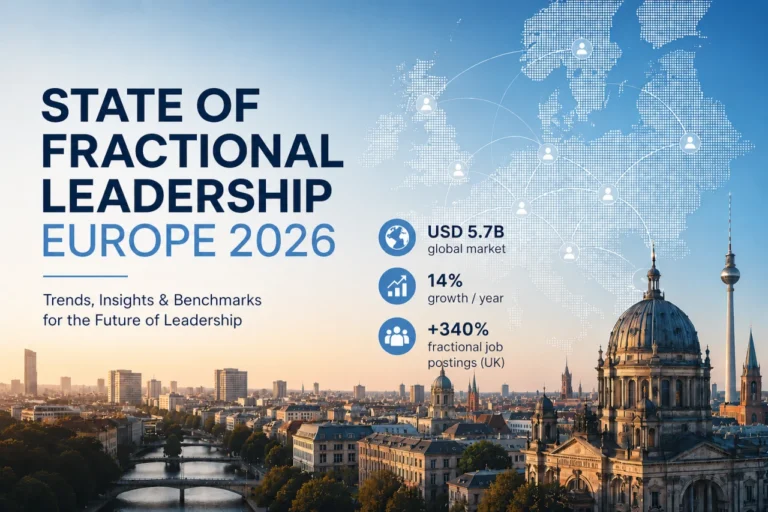
Estimates vary by methodology, but every source points the same direction: up, and quickly. According to fractional-market tracker Vendux, the global market for fractional executives has passed roughly USD 5.7 billion and is growing around 14% a year, with North America accounting for about 44% of the value — which leaves Europe as a smaller but fast-expanding share. Gartner forecasts that more than 30% of midsize enterprises will have at least one fractional executive on retainer by 2027.
| Indicator | Figure | Source |
|---|---|---|
| Global fractional executive market | ~USD 5.7B, growing ~14%/yr | Vendux, 2026 |
| Midsize enterprises with a fractional exec on retainer by 2027 | 30%+ | Gartner |
| CEOs planning to increase fractional use (next 12 months) | 72% | Vendux, 2026 |
| UK fractional job postings since 2019 | +340% | Vendux, 2026 |
| Mid-sized firms planning fractional/interim by mid-2026 | ~37% (up from 12% in 2020) | Korn Ferry, 2025 |
Is fractional leadership in Europe actually growing?
Yes — and the clearest signal is hiring activity. In the UK, one of Europe’s most developed markets, job postings mentioning “fractional” have grown by around 340% since 2019, and roughly 78% of scale-ups report having used or actively considered a fractional executive (Vendux). A 2025 Korn Ferry survey found that about 37% of mid-sized firms plan to use fractional or interim executives by mid-2026, up from just 12% in 2020.
There is also history here that the headlines miss: interim executive management was effectively invented in the Netherlands in the 1970s. Europe is not importing a foreign idea so much as scaling a flexible-leadership tradition it already had — now with a part-time, portfolio twist.
What is driving the shift?
Four forces are converging at once:
- Capital discipline. After the cheap-money years, European companies are expected to reach milestones with leaner teams. A full-time C-level hire at EUR 200k+ plus equity is hard to justify when the same expertise is available a few days a week.
- AI and regulation. The EU AI Act, NIS2, and DORA have turned AI governance, security, and operational resilience into board-level obligations — often before a company is large enough for full-time owners of each, which is exactly where a fractional CAIO, CISO, or CFO fits.
- Remote normalisation. Distributed work removed the assumption that a leader must be in one office five days a week, making a portfolio across several companies practical.
- A deeper talent pool. A generation of senior operators now actively chooses portfolio careers. According to Heidrick & Struggles’ 2026 Talent Lens survey, around 85% of interim leaders have worked independently for more than a year — this is a deliberate path, not a gap between jobs.
How far is Europe behind the US?
Behind, but closing — and unevenly. North America is the most mature market by value, and US adoption is further along (a quarter or more of US businesses already use some form of fractional hiring, by Vendux’s count). Within Europe, Western Europe leads — the UK, Germany, the Netherlands, and the Nordics have active communities of fractional CFOs, CMOs, and CTOs, concentrated in tech, finance, and SaaS. Southern Europe (Italy, Spain) has moved more slowly, partly because business cultures there favour long-term employment, while Central and Eastern European tech hubs such as Poland, Estonia, and the Baltics are at an earlier, fast-learning stage.
The practical reading: Europe is roughly where the US was a few years ago, which makes 2026 an unusually good moment to be early — on both sides of the market.
Which roles are moving fastest?
Finance and marketing led the way — the fractional CFO and fractional CMO are the most established roles in Europe. Technology and revenue are catching up fast: fractional CTOs and CROs are increasingly common as companies professionalise engineering and go-to-market. The newest entrants are regulation-driven: the fractional CISO (pushed by NIS2 and DORA) and the fractional CAIO (pushed by the EU AI Act and the scramble to turn AI pilots into production).
What it means — for companies and for leaders
For companies: fractional leadership is no longer a stopgap; it is a legitimate way to buy senior judgement at the dose your stage can justify, and the talent available is deepening. The skill to develop is engagement design — picking the right role, scope, and outcomes.
For experienced managers: the demand is real and rising faster than the supply of leaders who have positioned themselves for it. If you are weighing the move, our guide to becoming a fractional leader walks through the decision and the practical path.
Either way, Fractionista connects vetted fractional executives with European companies. Companies can post a brief and hire; experienced leaders can list themselves and be matched.
Frequently asked questions
How big is the fractional executive market?
Estimates vary, but Vendux puts the global fractional executive market at roughly USD 5.7 billion in 2026, growing around 14% a year. North America is the largest share (about 44%), with Europe smaller but expanding quickly.
Is fractional leadership growing in Europe?
Yes. UK fractional job postings have grown about 340% since 2019, around 78% of UK scale-ups have used or considered a fractional executive (Vendux), and Gartner expects 30%+ of midsize enterprises to have one on retainer by 2027.
Why are companies hiring fractional executives?
Mainly capital discipline (senior expertise without a full-time cost), new regulatory obligations (EU AI Act, NIS2, DORA) that need senior owners before a full-time hire is justified, the normalisation of remote work, and a deeper pool of leaders choosing portfolio careers.
Which European countries lead in fractional hiring?
Western Europe leads — the UK, Germany, the Netherlands, and the Nordics have the most active markets, concentrated in tech, finance, and SaaS. Southern Europe has been slower, and Central and Eastern European tech hubs are at an earlier but fast-growing stage.
Sources: Vendux (2026 fractional-executive data), Gartner, Korn Ferry (2025), Heidrick & Struggles 2026 Talent Lens. Figures are the latest available estimates and vary by methodology.