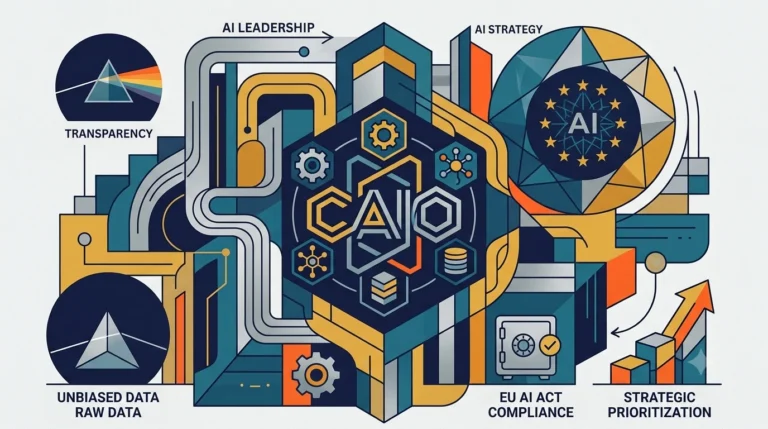
Fractional CAIO: A 2026 Guide to Part-Time AI Leadership in Europe

What a fractional CAIO does, how the EU AI Act is driving demand, how the role differs from a CTO, what it costs, and when part-time AI leadership is the right call.
Most European companies now run AI somewhere. A support team uses a chatbot, marketing generates copy, engineering ships a model into the product. What almost none of them have is a single person who owns how AI is chosen, deployed, governed, and defended to a regulator. That gap became a board-level problem on 2 August 2026, when the EU AI Act’s transparency obligations and the Commission’s enforcement powers took effect. Suddenly the question “who owns AI here?” needs a real answer, and “the CTO handles it on the side” is no longer one.
A fractional CAIO answers it. This guide covers what a Chief AI Officer does, why the EU AI Act has turned the role from a nice idea into a governance necessity, how it differs from a CTO, what it costs across European markets, and when part-time AI leadership makes more sense than a full-time hire.
What is a fractional CAIO?
A fractional CAIO is an experienced Chief AI Officer who leads your AI strategy and governance part-time and on an ongoing basis, typically one to two days per week. They own the same remit as a full-time CAIO, setting the AI agenda, prioritising use cases, and answering for AI risk and compliance, but without the cost and scarcity problem of a permanent hire.
The role is distinct from a consultant delivering an AI strategy deck and leaving, and from a data-science contractor building models. A fractional CAIO is accountable leadership: they decide what gets built, what does not, and how the whole thing stays on the right side of the law.
What does a fractional CAIO actually do?
The common misconception is that a CAIO is the most senior machine-learning engineer. In reality the role is about judgement, prioritisation, and governance far more than model building. A fractional CAIO typically owns:
- Set an AI strategy and a prioritised roadmap tied to real business outcomes, not hype
- Decide which use cases to pursue, and kill the ones that will not pay off
- Own AI governance and EU AI Act compliance, including risk classification and documentation
- Set the build-versus-buy line and choose vendors and models
- Establish policy on data, ethics, transparency, and acceptable use
- Upskill the leadership team and staff so adoption actually happens
- Report AI posture, risk, and return to the board
The goal is not the most AI. It is the right AI, deployed responsibly, with someone accountable when a regulator, a customer, or the board asks how it works.
Why are European companies hiring fractional CAIOs now?
The single biggest driver is regulation. The EU AI Act is the world’s first comprehensive AI law, and 2026 is the year it starts to bite.
Its prohibited-practice rules have applied since 2 February 2025, and obligations for general-purpose AI models since 2 August 2025. The pivotal date is 2 August 2026, when the Article 50 transparency obligations (disclosing AI chatbots, labelling AI-generated content and deepfakes) apply, the Commission’s enforcement powers over general-purpose AI activate, and national market-surveillance authorities gain full power to investigate and fine (digitalapplied, Legiscope). The heaviest fines, for breaches of the prohibited-practices rules, reach up to 35 million euro or 7 percent of global annual turnover. The high-risk system obligations were pushed back to 2 December 2027 under the Digital Omnibus agreed in May 2026 (Inside Global Tech), so companies have a window to get governance in place, but not a long one.
On top of the law, competitive pressure is real. Boards want an AI plan they can defend, not a scatter of pilots. Qualified AI leaders are scarce and expensive, which is exactly the condition under which a fractional model works: you get the seniority you cannot yet justify full-time, and you get it now rather than after a six-month search.
Fractional CAIO vs CTO: what is the difference?
This is the question most companies ask first, because they already have a CTO. The distinction is one of focus. A CTO owns the broad technology vision, the engineering organisation, the infrastructure, and the product build. A CAIO owns AI specifically: strategy, governance, ethics, adoption, and compliance across how the organisation discovers, builds, deploys, monitors, and governs AI systems (LeadDev).
In a smaller company the CTO often covers AI as one responsibility among many. The problem is that AI is now a full agenda in its own right, with its own regulatory regime, and it competes for attention with everything else a CTO carries. A fractional CAIO adds that focused ownership without duplicating the CTO. The two roles are complementary: the CTO keeps building the platform, the CAIO makes sure the AI on it is chosen well and governed properly. If you want the technology-leadership side, our fractional CTO route covers that remit.
When does a fractional CAIO fit, and when do you need full-time?
Fractional works when AI matters to you but is not yet a full-time, full-team concern. Consider it when:
- The EU AI Act now applies to how you use or build AI and nobody senior owns the response
- You have a scatter of AI pilots and need someone to prioritise and govern them
- Your CTO or founder is carrying AI on the side and it is not getting the focus it needs
- You want executive-grade AI judgement without a package north of 250,000 euro
Move to full-time when AI becomes the core of the business:
- AI is central to your product and revenue, with a dedicated team to lead day to day
- You operate high-risk AI systems that will fall under the 2027 obligations
- Regulatory or customer scrutiny demands a named, full-time accountable AI officer
Many companies run a fractional CAIO for 12 to 24 months to set the strategy, get governance compliant, and build internal capability, then either hire full-time or keep the fractional lead as ongoing oversight. If you are weighing the model itself, our guide on what a fractional role is sets out the basics.
What does a fractional CAIO cost in Europe?
The fractional CAIO commands the highest floor of any fractional executive role, because qualified AI leaders are so scarce. Senior day rates run from roughly 1,400 to 2,800 euro, with the top of the market at 2,800 euro and above, according to our fractional executive rates benchmark. At a typical one to two days per week, that puts a monthly retainer in the region of 6,000 to 22,000 euro depending on intensity and market.
Set that against a full-time hire. Chief AI Officer base salaries in Europe run from about 180,000 to 350,000 euro in 2026 (UK 180,000 to 320,000 pounds, Germany 170,000 to 300,000 euro, France 160,000 to 280,000 euro), and total compensation often exceeds base by 50 to 100 percent once equity and bonus are added (Chief AI Officer salary guide 2026). For most companies below the point where AI is the whole business, a fractional CAIO delivers the leadership at a fraction of that, with no recruitment lead time and the flexibility to scale up or step back.
How do you structure a fractional CAIO engagement?
Agree the outcomes you are buying, whether that is EU AI Act readiness, a prioritised AI roadmap, or a governance framework the board can sign off. Set a fixed cadence on a monthly retainer rather than paying by the hour, which creates the mutual commitment the relationship needs. Give the CAIO a real mandate and board access, because AI decisions that lack authority stall between departments.
A sensible first 90 days: an AI inventory and risk classification against the EU AI Act in month one, a prioritised roadmap and a governance and acceptable-use policy in month two, and by month three the highest-value use case moving and a repeatable review process in place. From there the work becomes steady execution, vendor decisions, and board reporting.
Frequently asked questions
What does CAIO stand for?
CAIO stands for Chief AI Officer, the executive who owns an organisation’s artificial-intelligence strategy, adoption, and governance. A fractional CAIO performs that role part-time and on an ongoing basis rather than as a full-time hire.
Do we need a CAIO if we already have a CTO?
Often yes, at least fractionally. A CTO owns broad technology and product, and AI competes with everything else on that plate. A CAIO gives AI focused ownership, including the governance and EU AI Act compliance that a CTO rarely has time to lead. In smaller companies the roles overlap, which is why a part-time CAIO alongside an existing CTO is a common and cost-effective setup.
Does the EU AI Act require us to have a CAIO?
No, the EU AI Act does not mandate a specific job title. It does require that AI systems are classified, documented, governed, and, for certain uses, transparent, and it makes companies accountable for compliance. In practice you need someone senior who owns that, and a fractional CAIO is a proportionate way to meet the expectation without a full-time hire.
How many days per week does a fractional CAIO work?
Most engagements run one to two days per week. During an EU AI Act readiness push or a major AI initiative it may sit at the higher end, then settle to a day per week or less of ongoing strategy and oversight once the framework is in place.
How is a fractional CAIO different from an AI consultant?
A consultant delivers a defined project, a strategy or an assessment, and then leaves. A fractional CAIO stays, carries ongoing accountability for AI outcomes and compliance, and is answerable for results over time rather than for a deliverable. If you need a one-off strategy, hire a consultant. If you need someone to own AI, hire fractionally.
How quickly can a fractional CAIO start?
Usually within days to a couple of weeks, which matters given how scarce senior AI leaders are and how quickly the EU AI Act deadlines are arriving. Recruiting a full-time CAIO can take many months, so a fractional hire lets you put accountable AI leadership in place before the next deadline or board review.
If the EU AI Act, a scatter of AI pilots, or a board that wants a real AI plan has put artificial intelligence on your agenda, a fractional CAIO is often the fastest proportionate answer. You can find a fractional CAIO through Fractionista, or read our companion guide on the fractional CISO, the other role Europe’s regulation is making essential.